
ISO 17025 CERTIFICATION IN ARUSHA: STRENGTHENING LABORATORY QUALITY FOR LONG-TERM SUCCESS
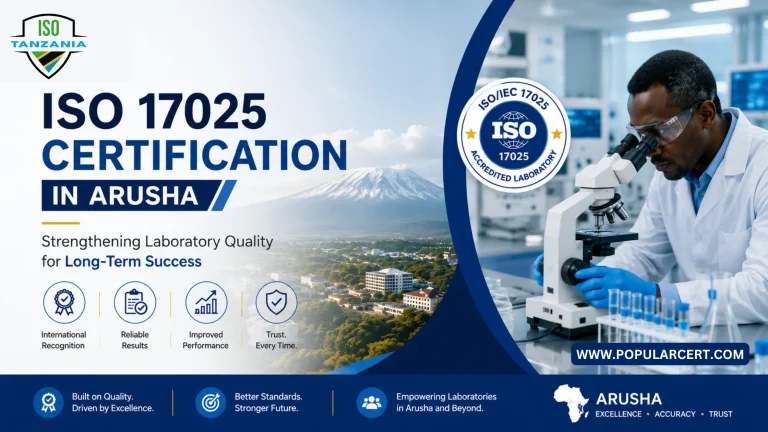
In the shadow of Mount Meru, Arusha has transformed into more than just a safari gateway; it is the heartbeat of East African trade and a burgeoning hub for industrial excellence. As the region’s economy diversifies into high-value agriculture, mining, and manufacturing, the demand for scientific precision has never been higher. At the center of this evolution are the laboratories, the silent arbiters of quality that determine whether a Tanzanian product is fit for the global stage.
For these institutions, ISO/IEC 17025 Certification in Arusha is not merely a regulatory requirement; it is the gold standard for laboratory competence that ensures long-term commercial viability.
The Strategic Importance of ISO 17025 in Arusha:
Arusha’s unique position as the headquarters of the East African Community (EAC) places it under an international spotlight. When a laboratory in Arusha issues a test report for soil nutrients, water purity, or mineral content, that report carries the weight of the region’s reputation.
- Global Acceptance of Data: The primary benefit of ISO 17025 is the "tested once, accepted everywhere" principle. For a lab in Arusha, this means that results are recognized by international bodies, facilitating easier exports for local businesses. Without this certification, local products often face redundant and expensive testing upon reaching foreign markets, which erodes profit margins and slows down the supply chain.
- Competitive Advantage in Local Tenders: As the Tanzanian government and private sectors tighten quality controls, ISO 17025 is becoming a prerequisite for high-value contracts. Laboratories that achieve this status immediately elevate themselves above competitors, proving they possess the technical infrastructure and staff expertise to handle complex analytical tasks.
The Core Pillars of ISO 17025:
Achieving certification involves a deep dive into both management systems and technical requirements. The standard is designed to ensure that every result produced is not only accurate but also reproducible and legally defensible.
1. Structural and Resource Requirements
ISO 17025 demands that a laboratory operates with total impartiality. This structural integrity ensures that commercial, financial, or other pressures do not influence the scientific results. Furthermore, it focuses heavily on:
- Personnel Competence: Ensuring that technicians are not only qualified on paper but have demonstrated their ability to perform specific tests.
- Environmental Controls: Maintaining the laboratory environment to ensure that temperature, humidity, and dust do not interfere with sensitive measurements.
- Equipment Management: Regular maintenance and rigorous calibration schedules to ensure that every instrument performs within its specified tolerances.
2. Process Requirements
The “life of a sample” is strictly governed by the standard, from the moment it is collected in the field until the final report is archived. Key processes include:
- Method Validation: Labs must prove that the methods they use are fit for their intended purpose.
- Handling of Test Items: Ensuring that samples are not contaminated or degraded during transport and storage.
- Assuring the Validity of Results: This involves regular participation in Proficiency Testing (PT) schemes, where the lab’s performance is compared against peer laboratories worldwide.
The Road to Regional Leadership: Arusha as a Quality Benchmark
Arusha’s strategic positioning within the East African Community (EAC) necessitates a laboratory infrastructure that is not just functional, but world-class. As the city continues to expand its role as a logistical and administrative epicenter, the laboratories operating within its borders face a unique opportunity to become regional leaders. ISO 17025 Certification acts as the primary vehicle for this transformation, shifting a laboratory from a local service provider to a globally recognized scientific authority.
Building Local Trust through Global Standards
In many markets, trust is built over decades of personal relationships; however, in the scientific community, trust is built through data. For an Arusha-based laboratory, achieving ISO 17025 accreditation is a public declaration of integrity. It signals to local farmers, mining conglomerates, and healthcare providers that their samples are being handled with the highest level of technical scrutiny. This trust is vital for long-term success, as it fosters deep-rooted partnerships with stakeholders who require uncompromising accuracy for their own compliance needs.
Enhancing Operational Resilience
The rigorous requirements of ISO 17025 specifically those concerning risk management and the “Silent Operator” approach create a more resilient business model. By identifying potential points of failure in the testing process, such as equipment drift or environmental fluctuations, laboratories in Arusha can implement preventative measures before errors occur. This proactive stance significantly reduces the “hidden costs” of laboratory management, such as the labor hours lost to troubleshooting or the financial impact of issuing incorrect reports.
Supporting the “Green Economy” in Tanzania
As Tanzania pivots toward sustainable development and a “Green Economy,” the role of environmental testing laboratories becomes paramount. ISO 17025 accredited labs in Arusha are essential for verifying carbon sequestration levels, monitoring water quality in protected areas, and ensuring that agricultural exports meet organic and pesticide-free standards. This alignment with national economic goals ensures that certified laboratories remain relevant and profitable as the market landscape shifts toward sustainability.
Overcoming Challenges in the Arusha Region
While the benefits are clear, the path to certification in Tanzania presents unique challenges. Many laboratories struggle with the initial costs of upgrading equipment or the complexity of developing a Quality Management System (QMS) from scratch.
The Documentation Hurdle:
ISO 17025 requires meticulous record-keeping. Every calibration, every training session, and every deviation from a standard operating procedure (SOP) must be documented. For many labs, moving from informal processes to a structured, audit-ready system is the most significant hurdle.
The ROI of Quality:
However, it is essential to view these costs as an investment rather than an expense. ISO 17025 leads to:
- Reduced Waste: Fewer errors mean fewer re-tests, saving on expensive reagents and labor.
- Risk Mitigation: Protecting the laboratory against legal liabilities by having a robust, defensible data trail.
- Customer Loyalty: Clients are more likely to return to a lab that consistently delivers reliable, internationally recognized reports.
Digital Evolution: The Future of Arusha Labs
To maintain long-term success, labs in Arusha are increasingly turning to technology. Implementing a Laboratory Information Management System (LIMS) is becoming a standard move for those seeking ISO 17025 accreditation. Digital systems reduce the risk of human error, automate the calculation of measurement uncertainty, and provide the data integrity that auditors from the Tanzania Bureau of Standards (TBS) and international accreditation bodies look for.
Why Choose Popularcert for ISO 17025 in Tanzania?
Achieving ISO 17025 Certification is a marathon, not a sprint. It requires a partner who understands both the international requirements of the standard and the specific logistical and regulatory environment of Arusha and the wider Tanzania region.
Popularcert has established itself as the premier ISO certification provider in Tanzania. We offer a hands-on approach that simplifies the certification process:
- Gap Analysis: We identify exactly where your laboratory stands today and what is needed to reach the finish line.
- Documentation Support: Our consultants help you develop a robust QMS that is practical for your staff to follow.
- Technical Training: We empower your team with the skills to manage measurement uncertainty and method validation independently.
- Internal Audit Assistance: Before the final assessment, we perform a mock audit to ensure you are 100% ready for the accreditation body.
By partnering with Popularcert, laboratories in Arusha can transition from being local players to recognized leaders in the global scientific community.
Conclusion: Securing the Future
ISO 17025 Certification is more than a certificate on a wall; it is a commitment to the truth of science. For Arusha’s laboratories, it is the most effective way to strengthen quality, ensure operational efficiency, and guarantee long-term success in an increasingly competitive world.
As Tanzania continues its path toward industrialization, the labs that embrace these standards today will be the ones leading the market tomorrow. Let Popularcert guide you through this transformation, turning your technical competence into your greatest business asset.
FAQ's
How does ISO 17025 certification benefit Arusha-based laboratories in the global market?
It enables the “tested once, accepted everywhere” principle, ensuring Arusha test reports are recognized by international trade partners. This removes the need for costly redundant testing when Tanzanian goods enter foreign markets.
What is the difference between ISO 9001 and ISO 17025 for a laboratory?
While ISO 9001 focuses on general management, ISO 17025 specifically mandates technical competence. It requires proof of scientific accuracy through method validation, metrological traceability, and technician proficiency.
How does Popularcert assist Arusha laboratories in achieving this accreditation?
Popularcert provides a clear roadmap through gap analysis, documentation support, and technical training. They simplify the process by conducting mock internal audits to ensure the laboratory is fully prepared for the final assessment.
How does ISO 17025 certification help Arusha laboratories save money long-term?
It reduces operational costs by minimizing errors and the need for expensive re-testing. By streamlining laboratory processes and ensuring equipment accuracy from the start, laboratories can significantly increase their profit margins and overall business resilience.