
ISO 17025 Certification In Tanzania
Strengthen Your Lab Standards – Go ISO 17025 in Tanzania with Confidence!
ISO 17025 Certification in Tanzania is an internationally recognized standard that ensures testing and calibration laboratories operate with technical accuracy, reliable results, and a commitment to continuous quality improvement. This certification boosts confidence among clients, regulators, and accreditation bodies by validating a lab’s competence.
In Tanzania, ISO 17025 is especially vital for laboratories engaged in environmental analysis, food safety testing, construction materials inspection, oil and gas evaluations, pharmaceutical assessments, and calibration services. The standard ensures that these labs meet rigorous quality and technical requirements to deliver accurate, consistent, and traceable results.
What is ISO 17025 Certification?
ISO 17025 Certification in Tanzania serves as the global benchmark for all testing and calibration laboratories regarding their technical competencies. It safeguards laboratories in Tanzania from inaccurate results and processes ensuring accuracy, reliability, and repeatability through validated processes and qualified personnel.
Get Free Consultation
ISO 17025 certification is beneficial for laboratories in the construction, manufacturing, environmental testing, pharmaceutical as well as food safety sectors. Laboratories are competent in testing and measuring and thus, the certification as well as the quality management systems greatly helps in gaining international standards.
With the certification, laboratories in Tanzania easily prove their accuracy in results and services, gaining the trust of clients while fulfilling the expectations of regulatory and accreditation bodies.
Importance of ISO 17025 Certification in Tanzania:
ISO 17025 Certification in Tanzania sets international standards for testing and calibration laboratories as a mark of operational technical accuracy and impartiality. It enables laboratories to implement robust quality management systems and consistently produce valid, reliable, and traceable results.
This certification fosters a laboratory’s credibility and improves operational efficiency while enhancing client trust. It is crucial for Tanzanian laboratories in cities like Mwanza, Dar es Salaam, Arusha, Dodoma, and Zanzibar seeking international recognition because it builds regulatory confidence, enables international acceptance, and promotes collaboration beyond borders. It spans all sectors and sizes of laboratories and helps them meet global benchmarks while distinguished for their professionalism.
How to Get ISO 17025 Certification in Tanzania ?
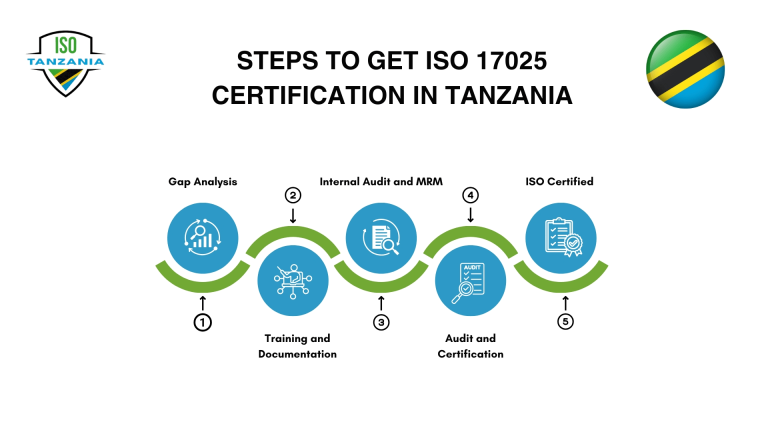
Steps to Achieve ISO 17025 Certification In Tanzania:
Understand ISO 17025 Requirements
Review the standard’s clauses to understand technical and management requirements relevant to your lab's testing and calibration services.
Conduct a Gap Analysis
Evaluate current practices against ISO 17025 to identify gaps in procedures, documentation, and technical competence that need improvement.
Implement Necessary Changes
Develop and update systems, train staff, and establish traceable calibration methods to align operations with ISO 17025 standards.
Internal Audit & Management Review
Conduct internal audits and management reviews to verify compliance and readiness before applying for external certification.
External Assessment & Certification
Apply through an accredited body for assessment; address any non-conformities and achieve ISO 17025 certification upon successful completion.
Benefits of ISO 17025 Certification In Tanzania:
- International Recognition: ISO 17025 certification makes Tanzanian laboratories globally recognized for their testing and calibration capabilities. It boosts credibility when dealing with international clients and regulatory bodies.
- Improved Accuracy & Reliability: The standard ensures consistent use of validated methods, calibrated equipment, and qualified staff—leading to more accurate and reliable lab results.
- Better Operational Efficiency: By following ISO 17025, labs streamline workflows, reduce errors, and establish effective quality management systems—saving time and resources.
- Increased Customer Trust: Clients and stakeholders are more confident in labs that follow internationally accepted standards. This certification shows a strong commitment to quality and technical competence.
- Enhanced Access to Tenders & Contracts: Many government and private sector contracts in Tanzania and beyond require ISO 17025 certification. Being certified gives laboratories a competitive edge in winning projects.
Key Pillars of ISO 17025 Implementation for Laboratories in Tanzania
Implementing ISO 17025 Certification is a systematic approach that ensures testing and calibration laboratories in Tanzania—whether in Mwanza, Dar es Salaam, Arusha, Dodoma, or Zanzibar—meet international standards of technical competence and accuracy. The process is built upon several essential pillars:
- Comprehensive Risk Assessment & Process Control: Laboratories must begin by thoroughly identifying potential risks and variables that may affect the accuracy and reliability of test results. This includes evaluating equipment precision, environmental conditions, human error potential, and procedural inconsistencies. Effective risk assessment leads to the development of control measures that mitigate uncertainties and enhance result validity.
- Establishing a Clear Quality Management System (QMS): A well-defined Quality Manual is fundamental. This document outlines the laboratory’s commitment to quality, defines roles and responsibilities across all levels, and sets forth structured procedures for maintaining technical integrity. It ensures that all staff are aligned with the laboratory’s quality objectives.
- Competency Development & Technical Training: Personnel competence is a cornerstone of ISO 17025. Laboratories must ensure their staff are well-trained in calibration techniques, testing procedures, uncertainty measurement, and quality control practices. Regular skill enhancement programs, workshops, and competency assessments are crucial for maintaining high technical standards.
- Proactive Equipment Maintenance & Calibration Schedules: Laboratories need to implement rigorous maintenance and calibration programs for all instruments and equipment. Detailed schedules, accurate calibration records, and the use of traceable standards are vital to ensure ongoing measurement accuracy and equipment reliability.
- Effective Incident Handling & Non-Conformity Management: An essential part of ISO 17025 is having a robust system to manage non-conformities and incidents. Laboratories must meticulously document discrepancies, investigate root causes, and apply corrective and preventive actions to ensure continuous improvement in processes and results.
- Internal Audits & Continuous Improvement: Periodic internal audits are vital to verify that the laboratory’s QMS and technical activities comply with ISO 17025 requirements. These audits help identify gaps, ensure compliance, and drive ongoing enhancement of laboratory practices, preparing the lab for successful external certification audits.
- Document Control & Record Management: ISO 17025 demands stringent control over documents and records. Laboratories must establish processes for maintaining up-to-date documentation, ensuring traceability, and safeguarding data integrity throughout their operations.
What Determines the Cost of ISO 17025 Certification in Tanzania?
The cost of obtaining ISO 17025 certification in Tanzania depends on several factors, including the size of the laboratory, the complexity of its operations, and whether the services provided involve testing, calibration, or both. Key expenses often include consultancy support to align lab processes with the standard, staff training for technical competency, preparation of quality and technical documentation, and audit fees from the certification body.
Larger or more diverse laboratories may incur higher costs due to extensive implementation needs and broader audit scopes. Additionally, travel expenses for auditors and local economic conditions can affect overall pricing. Despite the investment, ISO 17025 certification is a valuable asset—proving a laboratory’s technical competence and unlocking access to both national and international markets.
Why Choose ISO-Certification-Tanzania.com for ISO 17025 Certification in Tanzania?
ISO 17025 Certification allows testing and calibration laboratories in Tanzania to implement a robust quality management system that guarantees reliable and accurate results in compliance with international standards. With the right assistance, your laboratory can achieve international standards for technical competence and impartiality.
This is how ISO-certification-Tanzania.com can assist with your certification journey.
- Effective Certification Strategy: Efficient and more straightforward processes enhances better implementation.
- Professional Assistance: Your laboratory is brought into compliance with ISO 17025 standards by qualified consultants.
- Certification in Record Time: Achievement of certification using a well-structured approach.
- Specific Services: Your laboratory’s needs are directly addressed with the provision of tailored services.
- Continued Assistance: Help with compliance and certification over the years is still available.
- Lasting Benefits: Better systems and processes, a strengthened reputation, and increased trust from clients and regulatory agencies.
Achieve global standing and operational excellence now. Visit ISO-certification-Tanzania.com to get a free consultation and learn how your laboratory can take advantage of ISO 17025 Certification in Tanzania.
FAQ's
What is ISO 17025 certification and why is it important in Tanzania?
ISO 17025 is an international standard that specifies requirements for the competence of testing and calibration laboratories. It is essential in Tanzania for ensuring accurate, reliable, and internationally recognized results.
Which laboratories in Tanzania need ISO 17025 certification?
Any testing or calibration lab, including those in sectors like food, pharmaceuticals, construction, and environmental analysis, can benefit from ISO 17025 certification to demonstrate technical capability and quality assurance.
How long does it take to get ISO 17025 certified in Tanzania?
The timeline varies depending on the lab’s readiness and complexity. On average, the process can take 2 to 6 months, including gap analysis, documentation, training, and auditing.
What is the cost of ISO 17025 certification in Tanzania?
Costs depend on factors like the size of the lab, scope of testing or calibration, and consultancy support. A detailed quote is usually provided after initial assessment.