
ISO Certification In Tanzania
Join 100+ Tanzania Businesses Already ISO Certified – Fast, Affordable & Hassle-Free!
ISO certification in Tanzania shows that a company is dedicated to maintaining international benchmarks in quality, safety, or service. It helps companies demonstrate best practices, improves their operations, and provides a competitive advantage in the international marketplace. This certification is attained through a sequential process which includes, gap analysis, documentation, audit, change implementation, and finally, an audit from an accredited certification body.
What is ISO Certification?
ISO Certification is an official form of acknowledgement that a business, product, service, or system complies with standards set by International Standard Organization. These standards ensure quality, safety, efficiency, and consistency in various industries and markets around the world.
Obtaining an ISO Certification signifies that an organization is using a systematic approach and proven processes that meet global standards. Each international standard pertains to a specific area. ISO 9001 is for quality management, ISO 14001 for environmental management, ISO 45001 for occupational health and safety, and ISO 27001 for information security. Each standard is tailored to improve performance in specific areas.
Get Free Consultation
Importance of ISO Certification in Tanzania:
ISO Certification strongly impacts enhancing the quality, safety, and international competitiveness of businesses in Tanzania. ISO standards assist organizations in meeting international expectations and help improve their operational efficiency as the country continues to grow in sectors such as agriculture, manufacturing, mining, and tourism.
Tanzanian companies are able to gain international trust, access new export markets, and meet compliance deadlines with ISO certification. Other benefits include compliance with international regulatory standards, enhanced risk management, and improved customer satisfaction.
In the food processing industry, ISO 22000 ensures safety; in construction and manufacturing, ISO 9001 guarantees quality; and data security in IT is covered under ISO 27001.
ISO certification makes Tanzanian businesses more attractive to investors and customers, as the companies and organizations are demonstrating commitment to excellence and continuous improvement.
Your business can achieve a global level of reliability and performance with ISO certification, so don’t hesitate to get certified today.
How to Get ISO Certification in Tanzania ?
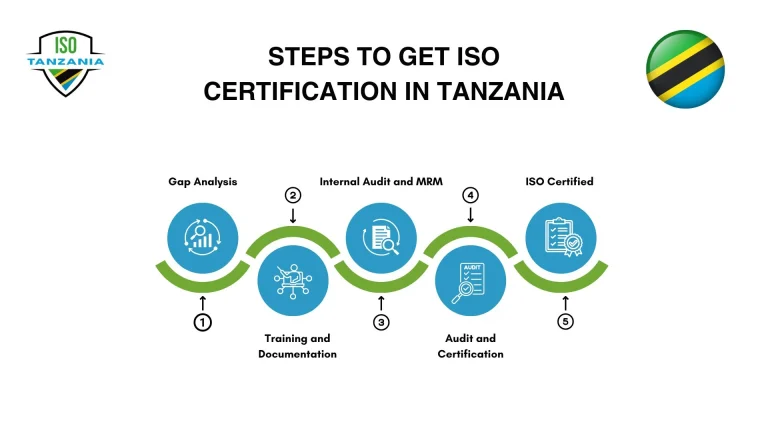
Steps to Achieve ISO Certification In Tanzania:
Choose the Right ISO Standard
Select the ISO standard that fits your business needs, like ISO 9001 for quality, ISO 14001 for environment, or ISO 45001 for workplace safety.
Gap Analysis & Documentation
Assess your current processes versus ISO requirements. Prepare or revise your policies, manuals, and procedures to align with the chosen standard.
Staff Training & System Implementation
Train employees on ISO practices. Implement necessary systems and processes to meet ISO guidelines in daily operations.
Internal Audit & Management Review
Perform an internal audit to spot gaps. Conduct a management review to confirm readiness for external evaluation.
External Audit & Certification
Engage an accredited certification body for the final audit. Upon success, receive your ISO certificate—valid for 3 years with yearly surveillance audits.
Tangible Benefits of ISO Certification In Tanzania:
- Increased Trust and Credibility: Trust and respect an organization earns instantly increases after acquiring an ISO certification. This is because their policies align with international benchmarks covering quality, safety, and reliability. Is the organization does ISO certification, its reputation is increased.
- Competitiveness of the Company in the Market: Processes where ISO standards are implemented becomes streamlined and wasteful practices are eliminated. Increased efficiency, decreased costs, and enhanced productivity are just a few benefits gained.
- Global Market Access: Expanding business potential and increasing revenue streams is attainable through global market expansion, all aided by ISO certification.
- Cost Savings and Operational Efficiency: Processes becomes streamlined with the implementation of ISO standards which eliminates unnecessary expenses.
- Effective Management of Risks: An ISO certified management system simplifies the processes of managing risks. This translates to a reduction in hiccups and responsibilities.
Industry-Specific ISO Standards Driving Tanzania’s Economic Growth
iso-certification-tanzania.com delivers customized ISO certification solutions across Tanzania, supporting industries in cities like Mwanza, Dar es Salaam, Arusha, Dodoma, and Zanzibar. Key ISO standards empowering Tanzania’s industrial and commercial sectors include:
- ISO 9001 (Quality Management System) The cornerstone for ensuring consistent product and service quality, ISO 9001 is essential for organizations of all sizes and industries aiming for global market recognition.
- ISO 14001 (Environmental Management System) Vital for organizations looking to minimize their environmental footprint. Particularly significant for sectors such as mining, construction, and manufacturing across Tanzania.
- ISO 45001 (Occupational Health & Safety Management) Critical for safeguarding employee well-being, especially in high-risk industries like construction, manufacturing, and mining operations in Dar es Salaam, Mwanza, and Arusha.
- ISO 27001 (Information Security Management System) Essential for protecting sensitive data and strengthening cybersecurity. Highly relevant for financial institutions, IT companies, and government entities in Dodoma and major urban centers.
- ISO 22000 (Food Safety Management System) Ensures food safety throughout the supply chain—from farm to fork. Crucial for food processing units, catering services, and export businesses in Zanzibar and beyond.
- ISO 17025 (Testing & Calibration Laboratories) Focused on laboratories to establish technical competence and ensure precise, reliable testing and calibration results, supporting quality assurance across industries.
- ISO 13485 (Medical Devices Quality Management System) Targeted for businesses involved in designing, manufacturing, and distributing medical devices, ensuring compliance with international healthcare standards.
Additional Certifications Enhancing Business Credibility in Tanzania:
Beyond ISO certifications, Tanzanian businesses can benefit from other globally recognized certifications that enhance credibility and unlock new markets:
- CE Marking: Mandatory for companies exporting specific industrial products to European Union markets. Essential for manufacturers in Arusha and Dar es Salaam seeking EU market access.
- Halal Certification: Opens up opportunities within Muslim-majority markets, both domestically and internationally. Vital for food producers, cosmetics, and consumer goods companies in Zanzibar, Mwanza, and Dodoma.
- GMP (Good Manufacturing Practices): Guarantees product quality and safety in sectors like pharmaceuticals, food production, and cosmetics manufacturing, crucial for businesses operating across all major Tanzanian cities.
For businesses in Mwanza, Dar es Salaam, Arusha, Dodoma, and Zanzibar, achieving these certifications through iso-certification-tanzania.com paves the way for enhanced trust, market competitiveness, and sustainable growth.
What Determines the Cost of ISO Certification in Tanzania?
In Tanzania, the cost for ISO certification is not uniform; rather, it is based on specific characteristics of your firm. The most prominent determining factors are the company’s headcount, the nature of your operations, the certification level, and the ISO standard you wish to obtain, for example, ISO 9001, ISO 14001, or ISO 22000.
Here is a list of factors that pertain to you, as well as why they would matter:
Consultancy Fees: It is crucial that you hire an ISO consultant. They will assist you in understanding the requirements, closing the gaps, and prepping for the audit.
Training Costs: Employees in different departments may require training to enable effective and confident implementation of ISO standards.
Document compliance: It includes the drafting and editing of policy documents, process, and procedure manuals, which is an essential part of compliance.
Certification Audit Fees: Setting audit fees is common practice for certifying institutions.
Surveillance Audits: After ISO certification, annual audits are conducted to ensure that standards are being upheld.
In addition to the listed items, for complex or larger-sized firms, the more extensive the audit and the deeper the review of the processes, the more costly it will be. Other factors that may affect the total cost include regional prices, as well as the travel costs for the auditors.
Why Choose ISO Tanzania.com for ISO Certification in Tanzania?
We provide businesses all over Tanzania with quick and affordable ISO certification at iso-certification-tanzania.com. Without any hassle, we assist you in achieving ISO 9001, ISO 14001, ISO 22000, and other certifications with the help of expert consultants, bespoke strategies, and comprehensive support. ISO certification aids in improving operational processes, compliance, and customer loyalty. Businesses in Tanzania, regardless of size, can rely on our support throughout the entire journey from documentation to certification. Trust us to help your business obtain ISO certififcation conveniently and reliably.
FAQ's
What is ISO certification and why is it important for businesses in Tanzania?
ISO certification is the mark given a business after undergoing international level auditing procedures. Such business will be trusted to maintain international standards in business relations. In Tanzania, it helps sustain trust, enhances processing, and opens up international business in a bigger market at a global stage.
Which ISO standards are most relevant for Tanzanian industries?
The key standards that the Tanzania business industries adopt are the most relevant and significant to the economy listed as follows.
ISO 9001 for Quality Management ISO 14001 for Environmental Management ISO 22000 for Food Safety ISO 45001 for Occupational Health & Safety ISO 27001 for Information Security
How long does it take to get ISO certified in Tanzania?
In Tanzania, ISO certification such as ISO 9001 takes about two to three month to complete. But globally within the international business level it takes around 4 to 12 weeks and it is highly dependable on the level and the size of the company as well as the business processing stage of the company and the adaption to the compliance and business procedures.
How much does ISO certification cost in Tanzania?
The certification is based highly on the other factors such as the size of the company, the dimension and the scope of works. In other consulting and documentation the company takes.
Who provides ISO certification in Tanzania?
The certification is given through other well-known companies. We follow all the processes such as planning and auditing then giving the company the certification.