
ISO 45001 VS ISO 14001: COMPARING WORKPLACE SAFETY AND ENVIRONMENTAL STANDARDS IN TANZANIA
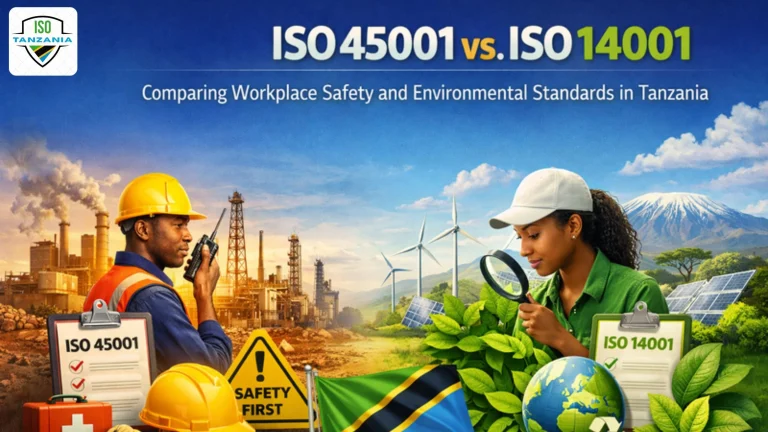
In today’s global market, businesses are increasingly judged not just by their financial performance but also by their ethical and sustainable practices. Two key standards that measure a company’s commitment to these areas are ISO 45001 (Occupational Health and Safety) and ISO 14001 (Environmental Management). In Tanzania, where industries are growing and a greater emphasis is being placed on both workplace safety and environmental protection, understanding these standards and choosing the right certification is crucial for any forward-thinking organization.
Here, we will compare ISO 45001 and ISO 14001, highlight their respective benefits, and guide Tanzanian businesses on which standard to prioritize or how to integrate both effectively. Finally, we will introduce Popularcert, a leading ISO Certification provider in Tanzania, to help you navigate this essential process.
Understanding ISO 45001: Occupational Health and Safety Management System (OH&SMS)
What is it?
ISO 45001 is the international standard for Occupational Health and Safety (OH&S). It provides a framework to manage and improve OH&S performance within an organization. Its primary goal is to prevent work-related injuries and illnesses and to provide safe and healthy workplaces.
How it works (PDCA Cycle):
ISO 45001 follows the Plan-Do-Check-Act (PDCA) cycle, a fundamental principle of continuous improvement.
- Plan: This stage involves establishing the OH&S policy, objectives, and processes needed to deliver results in accordance with the organization's OH&S policy. It includes identifying hazards, assessing risks, and identifying opportunities related to OH&S.
- Do: This stage involves implementing the processes as planned. It includes communicating the OH&S policy and requirements, providing training and resources, and managing operational controls.
- Check: This stage involves monitoring and measuring processes against the OH&S policy, objectives, and legal requirements. It includes conducting internal audits and reviewing the OH&S management system's performance.
- Act: This stage involves taking actions to continually improve the OH&S performance. It includes addressing nonconformities, identifying and acting on opportunities for improvement, and reviewing the effectiveness of the OH&S management system.
Key Benefits of ISO 45001:
- Improved Safety: This is the most significant benefit. By identifying hazards, assessing risks, and implementing controls, organizations can significantly reduce work-related accidents and diseases.
- Compliance with Legislation: ISO 45001 helps organizations identify and comply with relevant OH&S laws and regulations, reducing the risk of legal penalties and reputational damage.
- Reduced Costs: Implementing an OH&S management system can lead to lower insurance premiums, reduced absenteeism due to sickness or injury, and lower healthcare costs.
- Enhanced Reputation: A robust OH&S management system demonstrates a company's commitment to its employees' health and safety, which can improve its reputation among customers, investors, and other stakeholders.
- Increased Productivity: Healthy and safe workers are generally more productive. By creating a safer and more comfortable work environment, organizations can boost employee morale and motivation.
Understanding ISO 14001: Environmental Management System (EMS)
What is it?
ISO 14001 is the international standard for Environmental Management Systems (EMS). It provides a framework for organizations to protect the environment and respond to changing environmental conditions in balance with socio-economic needs.
How it works (PDCA Cycle):
Like ISO 45001, ISO 14001 is based on the PDCA cycle.
- Plan: This stage involves establishing an environmental policy, objectives, and targets. It includes identifying environmental aspects (how an organization's activities, products, or services interact with the environment) and determining which of these aspects have significant environmental impacts.
- Do: This stage involves implementing the planned processes. It includes assigning responsibilities, providing training, communicating environmental information, and controlling operations to minimize environmental impact.
- Check: This stage involves monitoring and measuring environmental performance against the environmental policy and objectives. It includes conducting internal audits and tracking key environmental indicators (e.g., energy consumption, waste generation, emissions).
- Act: This stage involves taking actions to continually improve environmental performance. It includes reviewing the EMS's effectiveness, addressing nonconformities, and identifying opportunities for improvement.
Key Benefits of ISO 14001:
- Reduced Environmental Impact: By identifying and controlling environmental aspects, organizations can significantly reduce their environmental footprint, contributing to sustainability.
- Cost Savings: Implementing an EMS often leads to more efficient use of resources (energy, water, raw materials), reducing waste generation and disposal costs.
- Compliance with Environmental Regulations: ISO 14001 helps organizations stay abreast of changing environmental laws and regulations, reducing the risk of fines and legal action.
- Enhanced Reputation: Demonstrating environmental responsibility can boost a company's image, attract environmentally conscious customers and investors, and differentiate it from competitors.
- Improved Resource Efficiency: The standard encourages a proactive approach to resource management, leading to improved resource utilization and reduced waste.
Side-by-Side Comparison: ISO 45001 vs. ISO 14001
While both standards aim to improve an organization’s overall performance and align with the principles of sustainability, they differ in their scope and focus.
| Feature | ISO 45001 (OH&SMS) | ISO 14001 (EMS) |
|---|---|---|
| Focus | People (Occupational Health & Safety) | Planet (Environmental Impact) |
| Goal | Prevent injury and ill health to workers | Protect the environment and prevent pollution |
| Core Elements | Hazard identification, Risk assessment, Incident investigation | Environmental aspects, Significant impacts, Life cycle perspective |
| Structure | ISO High-Level Structure (Annex SL) | ISO High-Level Structure (Annex SL) |
| Scope | Internal workforce, contractors, visitors | External environment (air, water, land, natural resources, flora, fauna, humans, and their interrelation) |
| Example Concerns | Slips, trips, falls, ergonomic risks, chemical exposure, stress | Waste generation, energy consumption, water usage, air emissions, chemical spills |
| Legislation | Labour laws, safety regulations (e.g., OSHA in Tanzania) | Environmental laws, waste management regulations (e.g., NEMC in Tanzania) |
| Primary Beneficiaries | Employees, contractors, workers | Society, ecosystems, future generations, local communities |
| Integration | Easily integrates with ISO 14001 and ISO 9001 | Easily integrates with ISO 45001 and ISO 9001 |
High-Level Structure (Annex SL): The Foundation for Integration
A key similarity between ISO 45001 and ISO 14001 is that they both follow the ISO High-Level Structure (Annex SL). This structure is designed to promote compatibility between different management system standards, making it easier for organizations to integrate them into a single, comprehensive management system (IMS).
The High-Level Structure consists of common clauses, definitions, and terminology, which simplifies the process of understanding and implementing multiple standards. For example, clauses related to:
- Context of the Organization
- Leadership
- Planning
- Support
- Operation
- Performance Evaluation
- Improvement
are all structured similarly in both standards, allowing organizations to streamline their documentation, processes, and audits.
Which Standard Should Your Tanzanian Business Prioritize?
The decision to prioritize ISO 45001 or ISO 14001 often depends on your specific industry, business activities, and immediate priorities.
Prioritize ISO 45001 If:
- You Operate in a High-Risk Industry: Construction, mining, manufacturing, transportation, and agriculture are industries with inherent risks to worker safety. ISO 45001 can be vital for reducing accidents and injuries.
- You Need to Ensure Compliance: You face pressure from regulators, customers, or internal stakeholders to meet health and safety requirements.
- Employee Welfare is a Top Priority: You recognize that a safe and healthy workforce is essential for employee satisfaction and productivity.
- You've Had a History of Workplace Incidents: A strong focus on OH&S is needed to address past issues and prevent future occurrences.
Prioritize ISO 14001 If::
- Your Operations Have Significant Environmental Impacts: Manufacturing, waste management, and energy production are examples of industries where environmental management is critical.
- You are Driven by Environmental Compliance: You face strict environmental regulations that require careful management.
- You Want to Reduce Resource Consumption and Waste: You recognize the cost-saving potential of efficient resource management.
- Your Brand is Associated with Sustainability: You want to demonstrate your commitment to environmental responsibility to customers and stakeholders.
The Benefits of an Integrated Management System (IMS)
In today’s complex business environment, most organizations face both safety and environmental challenges. Rather than managing them separately, a smarter approach is to integrate ISO 45001 and ISO 14001 into a single, comprehensive management system (IMS).
An IMS allows you to:
- Reduce Duplication: Eliminate redundant processes, documentation, and effort.
- Simplify Management: Streamline governance, reporting, and auditing.
- Improve Consistency: Ensure that safety and environmental considerations are integrated across all business operations.
- Optimize Resources: Direct resources more effectively towards achieving overall organizational goals.
- Gain a Holistic View: Improve decision-making by considering safety, environment, and other management system aspects together.
Given the common High-Level Structure, integrating these standards is often much more straightforward and cost-effective than attempting separate implementations.
Popularcert: Your Trusted Partner for ISO Certification in Tanzania
Navigating the intricacies of ISO certification can be a daunting task. That’s where Popularcert steps in. We are a leading provider of ISO certification services in Tanzania, with a team of highly experienced and qualified auditors and consultants dedicated to guiding businesses through the entire process.
Why Choose Popularcert?
- Expertise in Tanzania: We have an in-depth understanding of the Tanzanian business landscape and regulatory environment, including the specific requirements for OSHA and NEMC compliance.
- Comprehensive Services: We offer a wide range of services, including:
- Gap Analysis: We assess your current processes against the relevant ISO standards to identify areas for improvement.
- Training: We provide training courses to equip your staff with the knowledge and skills needed to implement and maintain your management system.
- Consultancy: Our experts guide you through every step of the certification process, from system development to implementation.
- Certification Audits: We conduct rigorous certification audits to ensure your management system meets the requirements of the chosen ISO standards.
- Tailored Solutions: We understand that every business is unique. We provide customized solutions tailored to your specific needs and objectives.
- Global Recognition: Our certification services are internationally recognized, giving your business a competitive edge.
- A Commitment to Customer Satisfaction: We are dedicated to providing excellent customer service and supporting your organization throughout its certification journey.
Conclusion:
ISO 45001 and ISO 14001 are both powerful tools that can help Tanzanian businesses improve their overall performance, satisfy stakeholders, and gain a competitive advantage. While ISO 45001 prioritizes workplace safety and worker well-being, ISO 14001 focuses on protecting the environment and promoting sustainable practices.
Choosing between the two standards, or implementing both, depends on your organization’s specific needs, priorities, and resources. Given the common High-Level Structure, an Integrated Management System is often the most efficient and effective long-term solution.
Ultimately, achieving ISO Certification is a worthwhile investment for any organization that wants to demonstrate its commitment to safety, environmental responsibility, and overall excellence. With the expert guidance and support of Popularcert, your Tanzanian business can successfully navigate this journey and reap the numerous benefits that ISO certification has to offer. Take the first step towards a safer, more sustainable, and successful future, contact Popularcert today!
FAQ's
What is the main difference between ISO 45001 and ISO 14001?
ISO 45001 focuses on occupational health and safety, while ISO 14001 focuses on environmental management and reducing environmental impact.
Which organizations in Tanzania should implement ISO 45001 and ISO 14001?
Industries such as manufacturing, construction, mining, and energy companies benefit from implementing both standards.
Can a company implement ISO 45001 and ISO 14001 together?
Yes, many organizations integrate both standards to manage workplace safety and environmental responsibilities effectively.
Why are ISO 45001 and ISO 14001 important for Tanzanian businesses?
They help improve safety, protect the environment, support regulatory compliance, and enhance organizational reputation.