
THE TRUE ISO CERTIFICATION COST IN DAR ES SALAAM:
WHAT BUSINESSES SHOULD KNOW
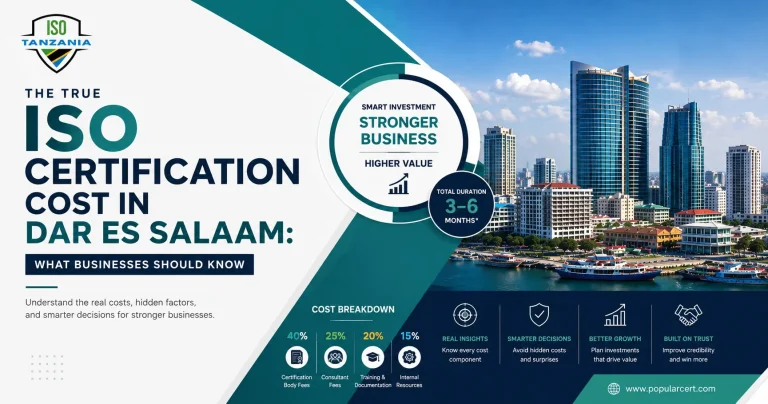
Thinking about ISO Certification in Dar es Salaam but unsure what it really costs? You’re not alone. Quotes vary wildly between consultants and certification bodies, leaving many business owners confused, overpaying, or settling for a shortcut certificate that means nothing in the real market. This guide breaks down the true cost of ISO Certification in Tanzania, what drives the price, hidden fees to watch for, and how to choose a partner offering real value. Along the way, discover why Popularcert is a trusted name for genuine, affordable ISO certification.
Why ISO Certification Matters for Businesses in Dar es Salaam?
Before we talk about cost, it helps to understand why ISO Certification is worth the investment in the first place.
Dar es Salaam is Tanzania’s commercial hub. It hosts manufacturers, exporters, logistics companies, food processors, construction firms, IT service providers, and countless small and medium enterprises trying to grow beyond the local market. For many of these businesses, ISO Certification is not just a nice badge to display in the office. It is often a requirement to:
- Win government or international tenders
- Export goods to regulated markets
- Build trust with foreign buyers and investors
- Improve internal processes and reduce waste
- Meet the requirements of larger clients who demand certified suppliers
Whether it is ISO 9001 for quality management, ISO 14001 for environmental management, ISO 45001 for occupational health and safety, or ISO 22000 for food safety, the right Certification can open doors that would otherwise stay closed. This is exactly why understanding the real cost, and avoiding shortcuts, matters so much.
What Actually Determines ISO Certification Cost in Dar Es Salaam?
There is no single fixed price for ISO certification, and any provider who gives you a number without asking about your business is likely not being fully honest with you. The true cost depends on several factors.
- Size of Your Organization: A business with five employees and one small office will naturally cost less to certify than a manufacturing plant with two hundred staff and multiple departments. Certification bodies assess your organization based on staff count, number of processes, and complexity of operations, and this directly affects audit time and, therefore, price.
- The ISO Standard You Are Applying For: Different standards require different levels of assessment. ISO 9001 (Quality Management) is generally more straightforward, while standards like ISO 22000 (Food Safety) or ISO 27001 (Information Security) may require more technical review, especially if your industry has specific regulatory demands.
- Current State of Your Management System: If your business already has documented processes, quality checks, and basic structure in place, the Certification body will spend less time helping you build a system from scratch. If you are starting from zero, expect more consulting hours, more documentation work, and naturally, a higher cost.
- Number of Locations: If your business operates from multiple branches or sites in Dar es Salaam or across Tanzania, each additional location may need to be audited, which increases both time and cost.
- Consulting and Implementation Support: Some businesses choose to handle the entire documentation and implementation process themselves. Others prefer expert guidance to move faster and avoid costly mistakes. This support, when needed, is usually a separate cost from the Certification audit itself.
- Certification Body Fees: This includes the actual audit fees charged by the Certification body, which covers the initial assessment, Certification decision, and ongoing surveillance audits required to keep your certificate valid.
The Hidden Costs Many Businesses Do Not Expect:
This is where many business owners in Dar es Salaam get caught off guard. Some providers advertise a low headline price, then add extra charges later. Common hidden costs include:
- Surveillance audit fees: ISO Certification is not a one-time event. Certified companies undergo annual surveillance audits to maintain their certificate, and some providers do not clearly explain this upfront.
- ReCertification costs: Certificates typically need renewal every three years, and this comes with its own cost.
- Travel and logistics charges: Some Certification bodies add extra fees for auditor travel, especially if they are not locally based.
- Documentation support fees: If your business needs help building manuals, policies, and records, this can be billed separately and sometimes at a high rate.
- Rush or expedited processing fees: Businesses in a hurry to meet a tender deadline are sometimes charged premium rates for faster turnaround.
None of these costs are inherently wrong to charge. The real problem is when they are not disclosed clearly from the start, leaving businesses with unpleasant surprises halfway through the process.
The Danger of Choosing the Cheapest Option:
It is tempting to simply choose whichever provider quotes the lowest price. But in the ISO Certification world, the cheapest option is often the most expensive mistake a business can make.
Here is why. ISO Certification only has value if it is issued by a credible, properly accredited Certification body whose certificates are recognized by clients, regulators, and international markets. Unfortunately, Dar es Salaam and the wider Tanzanian market have seen cases of businesses receiving certificates that look official but are not backed by proper accreditation. These certificates may satisfy a quick internal need, but they collapse the moment a serious client, auditor, or export authority checks their validity.
When that happens, the business has to start the entire process again, this time paying twice for what should have been done properly the first time. The true cost of ISO certification, therefore, is not just about the number on the invoice. It is about getting a certificate that actually works for your business, today and in the future.
A Realistic Way to Think About ISO Certification Cost in Dar Es Salaam:
Rather than searching for a single fixed figure, businesses in Dar es Salaam should think about ISO Certification cost as an investment made up of three parts:
- Preparation cost: building or improving your management system, documentation, and internal processes
- Certification audit cost: the fee paid to the Certification body to assess and certify your business
- Maintenance cost: surveillance audits and renewal over the three-year Certification cycle
When you understand the process this way, it becomes much easier to compare providers fairly. A provider that seems expensive upfront but includes proper documentation support, transparent surveillance fees, and genuine accreditation may actually cost less overall than a “cheap” provider that adds charges at every stage.
How to Choose the Right ISO Certification Partner in Dar es Salaam?
When evaluating a Certification provider, ask these questions before signing anything:
- Is the Certification body properly accredited, and can they show proof?
- Is the full cost breakdown provided in writing, including surveillance and renewal fees?
- Does the provider offer support tailored to your industry and business size?
- How long has the provider worked with businesses in Tanzania, and can they show real client results?
- Will your certificate be recognized internationally if you plan to export or work with foreign clients?
A provider that answers these questions clearly and confidently, without pressuring you into a rushed decision, is usually one worth trusting.
Why Popularcert Is a Trusted Choice for Businesses in Dar es Salaam?
This is where Popularcert stands out from many other providers in the market.
Popularcert has built its reputation on transparency, something that is genuinely rare in the ISO Certification space. From the very first consultation, Popularcert takes the time to understand your business size, industry, and specific goals before giving you a quote. There are no vague promises and no hidden charges that appear later in the process.
What makes Popularcert particularly valuable for businesses in Dar es Salaam includes:
- Clear, upfront pricing that covers preparation, certification, and ongoing maintenance, so you know exactly what you are paying for from day one.
- Genuine, internationally recognized certification, meaning your certificate holds real weight with clients, tenders, and export markets, not just a document to display and forget.
- Support across a wide range of standards, including ISO 9001, ISO 14001, ISO 45001, ISO 22000, and ISO 27001, tailored to what your specific business actually needs.
- Hands-on guidance through the entire process, from gap analysis and documentation to audit preparation, so you are not left figuring things out alone.
- A team that understands the Tanzanian business environment, meaning practical advice that fits how businesses in Dar es Salaam actually operate, not generic templates copied from elsewhere.
- Ongoing support after certification, helping businesses stay ready for surveillance audits and successfully maintain their certificate over the years, rather than disappearing once the certificate is issued.
For businesses that have been burned before by unclear pricing or certificates that did not hold up when it mattered, Popularcert offers a refreshing, honest approach. The goal is not just to hand you a certificate, but to help build a management system that genuinely improves how your business runs, while making sure the Certification itself is respected wherever you present it.
Final Thoughts:
The true cost of ISO Certification in Dar es Salaam is not a single number you can find with a quick search. It depends on your business size, the standard you need, your current systems, and the Certification partner you choose. What matters most is not finding the cheapest option, but finding a transparent, accredited, and reliable partner who gives you real value for every shilling spent.
If you are ready to move forward with confidence, working with a trusted name like Popularcert means you get honest pricing, genuine international recognition, and support that goes beyond just issuing a certificate. It is an investment in your business’s credibility, growth, and long-term success.
If your business in Dar es Salaam is considering ISO certification, reach out to Popularcert today for a clear, honest consultation on what the process will actually involve and cost for your specific business.
FAQ's
How much does ISO Certification cost in Dar es Salaam?
The cost of ISO Certification in Dar es Salaam depends on the ISO standard, business size, number of employees, locations, process complexity, and existing management systems. Consultant, audit, and certification body fees can also affect the total cost.
What factors affect ISO Certification costs in Dar es Salaam?
Key cost factors include the chosen ISO standard, scope of certification, number of sites, employee count, documentation requirements, training, consultant support, audit duration, and certification body fees. Businesses with established processes may require less preparation.
How long does ISO Certification take in Dar es Salaam?
The timeline varies based on the organization’s readiness and the standard being implemented. In many cases, businesses can complete the implementation and certification process within 3–6 months, although complex or multi-site organizations may take longer.
Can a consultant help reduce ISO Certification costs?
Yes. An experienced ISO consultant can help identify gaps, develop practical documentation, train employees, and prepare the organization for certification audits. This can reduce delays, rework, and unnecessary implementation expenses while making the certification process more efficient.