
ISO 14001 CERTIFICATION IN TANZANIA FOR THE MINING INDUSTRY: TURNING ENVIRONMENTAL RISK INTO BUSINESS VALUE
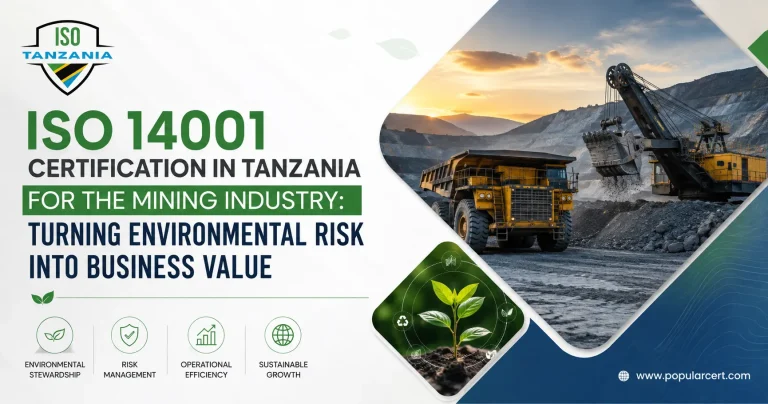
Mining in Tanzania comes with real environmental risk, land disturbance, water contamination, waste, and community impact. ISO 14001 certification in Tanzania helps mining companies manage that risk while building trust with regulators, investors, and international buyers. Rather than treating environmental compliance as a burden, forward-thinking mining businesses are using ISO 14001 to strengthen operations, win contracts, and protect their reputation. This blog explains what ISO 14001 means for the mining sector, why it matters now more than ever, and how Popularcert helps mining companies turn environmental responsibility into a genuine business advantage.
Why Environmental Management Is No Longer Optional in Mining
Tanzania’s mining sector is one of the country’s most important economic engines. Gold, tanzanite, coal, gemstones, and other minerals draw investment from around the world and create thousands of jobs across regions like Geita, Shinyanga, Mwanza, and Mara. But mining also carries a reputation for environmental damage, deforestation, soil erosion, water pollution, dust, chemical runoff, and disruption to local communities.
For decades, some mining operations treated environmental management as an afterthought, something to deal with only when regulators demanded it or when problems became too visible to ignore. That approach no longer works. Regulatory bodies like the National Environment Management Council (NEMC) have tightened enforcement. International investors and buyers now expect proof of responsible operations before they commit capital or sign supply agreements. Communities near mining sites are more vocal about the impact on their land, water, and health.
This shift has pushed environmental management from a compliance checkbox to a genuine business priority. And this is exactly where ISO 14001 Certification becomes valuable, not as a formality, but as a structured, internationally recognized way to manage environmental risk while strengthening the business itself.
What ISO 14001 Actually Means
ISO 14001 is the global standard for Environmental Management Systems (EMS). It gives an organization a structured framework to identify environmental risks, set measurable objectives, reduce negative impact, and continuously improve performance over time.
For a mining company, this framework typically covers areas such as:
- Land use, disturbance, and rehabilitation planning
- Water usage, discharge, and contamination control
- Waste management, including hazardous and chemical waste
- Air quality and dust control
- Energy consumption and efficiency
- Emergency preparedness for environmental incidents
- Compliance with Tanzanian environmental laws and international expectations
Importantly, ISO Certification does not require a mining company to stop operations or eliminate all environmental impact overnight. Instead, it requires the company to understand its impact clearly, manage it responsibly, and demonstrate continuous improvement. This makes it realistic and achievable for mining operations of different sizes, from large-scale mining companies to smaller, growing operations across Tanzania.
Why Mining Companies in Tanzania Should Pay Attention Now
- Regulatory Pressure Is Increasing: Tanzanian authorities have become stricter about environmental compliance in the mining sector, with tighter monitoring, more frequent inspections, and harsher penalties for violations. Mining companies with a structured environmental management system are far better positioned to meet these requirements consistently, rather than scrambling to respond after an inspection flags a problem.
- International Buyers and Investors Expect It: Many international buyers, particularly in gold and gemstone markets, are under growing pressure from their own regulators and consumers to source responsibly. Increasingly, they ask suppliers to demonstrate environmental accountability before agreeing to purchase. A mining company holding ISO 14001 certification sends a clear signal that its operations meet internationally recognized environmental standards, which can be the deciding factor in securing or losing a valuable contract.
- Access to Financing Is Tied to Environmental Performance: Banks, development finance institutions, and international investors increasingly assess environmental risk before approving loans or investment for mining projects. Companies with a certified environmental management system present a lower risk profile, which can translate into easier access to financing and more favorable terms.
- Community and Reputation Risk Is Real: Environmental incidents, even small ones, can damage community relationships and a company's public reputation quickly. Rehabilitating that trust afterward is far more expensive and time-consuming than preventing the incident in the first place. A structured EMS helps mining companies identify risks early, before they become costly problems.
- Operational Efficiency Improves: This is a benefit many mining companies overlook. Managing environmental risk properly often means using resources more efficiently, reducing waste, using water more carefully, and lowering energy consumption. These improvements do not just protect the environment; they reduce operating costs over time.
Turning Environmental Risk into Business Value
The real shift happens when mining companies stop viewing environmental management as a cost of doing business and start viewing it as a source of business value. Here is how ISO 14001 Certification in Tanzania supports that shift.
- It builds credibility with regulators: Instead of reacting to inspections and penalties, certified companies can demonstrate an ongoing, documented commitment to environmental responsibility, which often leads to smoother regulatory relationships.
- It opens doors internationally: Export markets and international buyers increasingly filter out suppliers who cannot demonstrate credible environmental practices. Certification puts Tanzanian mining companies on a stronger footing to compete for these opportunities.
- It reduces long-term liability: Environmental violations can result in significant fines, legal consequences, and forced operational shutdowns. A properly implemented EMS reduces the likelihood of these outcomes by catching risks before they escalate.
- It strengthens investor confidence: Investors want assurance that a mining operation will not become an environmental liability. Certification provides that assurance in a form investors recognize and trust.
- It improves community relationships: Demonstrating genuine environmental responsibility, backed by a recognized standard, helps mining companies build and maintain trust with the communities they operate near, reducing conflict and disruption to operations.
In short, ISO 14001 does not just protect the environment. It protects the business itself, its licence to operate, its reputation, its financing options, and its long-term growth.
Common Challenges Mining Companies Face During Certification
Getting ISO 14001 certified is achievable, but it is worth being honest about the common challenges mining companies encounter along the way.
- Complex operations across multiple sites: many mining companies operate across several locations, each with different environmental risks, which requires careful planning during implementation.
- Limited internal environmental expertise: smaller mining operations may not have dedicated environmental staff, making external guidance valuable during the process.
- Balancing production targets with new processes: introducing structured environmental controls alongside daily production demands requires careful planning so operations are not disrupted.
- Keeping documentation consistent and audit-ready: mining sites generate a large amount of operational data, and organizing this properly for certification purposes takes structured support.
These challenges are exactly why choosing the right certification partner matters. A partner who understands mining operations specifically, not just generic ISO frameworks, makes the entire process smoother and far more effective.
What to Look for in an ISO 14001 Certification Partner for Mining
Not every certification provider understands the specific realities of the mining industry. When evaluating a partner, mining companies should look for:
- Experience working with mining or extractive industry clients specifically
- A clear understanding of Tanzanian environmental regulations and NEMC requirements
- Practical, site-based support rather than generic documentation templates
- Transparent pricing that covers implementation, certification, and ongoing surveillance audits
- A team that can explain environmental risk in terms that connect to real business outcomes, not just compliance language
Why Popularcert Is the Right Partner for Mining Companies in Tanzania
This is exactly the gap Popularcert fills for mining companies across Tanzania.
Popularcert understands that mining operations are not the same as a typical office-based business seeking certification. Environmental risk in mining is physical, operational, and often site-specific, which means a generic, one-size-fits-all approach simply does not work. Popularcert’s team takes the time to understand the actual footprint of your mining operation, from land disturbance to water usage to waste handling, before building an environmental management system that genuinely fits your business.
Here is what makes Popularcert a trusted choice for ISO 14001 Certification in Tanzania’s mining sector:
- Industry-relevant expertise: with guidance shaped around the real environmental risks mining companies face, not generic templates borrowed from unrelated industries.
- Clear, transparent pricing: covering implementation support, certification audits, and ongoing surveillance, so mining companies know exactly what to expect financially from the start.
- Genuine, internationally recognized certification, meaning your ISO 14001 certificate carries real weight with regulators, investors, and international buyers.
- Practical implementation support, helping mining companies build environmental controls that work alongside daily production, not against it.
- Local regulatory knowledge, ensuring your environmental management system aligns with NEMC requirements and Tanzanian mining regulations, not just international theory.
- Ongoing support after certification, helping mining companies stay prepared for surveillance audits and maintain certification confidently over the full three-year cycle.
For mining companies in Tanzania looking to strengthen their environmental credibility while protecting long-term business value, Popularcert offers a partnership built on genuine understanding of the industry, not just paperwork.
Final Thoughts:
Environmental risk in mining is not going away, and neither is the pressure to manage it responsibly. What forward-thinking mining companies in Tanzania are learning is that environmental management, done properly through ISO 14001 certification, is not just about avoiding penalties. It is about building a stronger, more credible, more resilient business that regulators trust, investors want to fund, and international buyers want to work with.
If your mining company in Tanzania is ready to turn environmental risk into a genuine business advantage, Popularcert is ready to guide you through a certification process built specifically around the realities of your operations. Reach out to Popularcert today for a clear, honest consultation on what ISO 14001 Certification in Tanzania can do for your mining business.
FAQ's
How long does it take to get ISO 14001 certified for a mining operation in Tanzania?
Timelines vary depending on the size and complexity of the mining operation, but most companies complete the process in three to six months. This includes a gap analysis, building or improving the environmental management system, staff training, an internal audit, and finally the certification audit. Larger operations with multiple sites may take longer due to the added coordination involved.
Does ISO 14001 certification mean a mining company has zero environmental impact?
No. ISO 14001 does not require zero impact, it requires the company to identify its environmental risks accurately, manage them responsibly, and show continuous improvement over time. It is a realistic, achievable standard built around ongoing progress rather than perfection, which makes it practical for mining operations of different sizes.
Is ISO 14001 certification a legal requirement for mining companies in Tanzania?
ISO 14001 itself is not a legal requirement, but it strongly supports compliance with Tanzanian environmental laws and NEMC regulations. Many mining companies pursue it voluntarily because it makes regulatory compliance more consistent and because it is increasingly expected by investors, international buyers, and financial institutions, even where it is not legally mandated.
How much does ISO 14001 certification cost for a mining company?
The cost depends on factors like the size of the operation, number of mining sites, current state of environmental controls, and level of implementation support needed. Rather than quoting a flat fee, a reliable provider like Popularcert assesses your specific operation first, then gives a transparent breakdown covering implementation, certification audit, and ongoing surveillance costs, so there are no surprises later.